
When you start a new job, one of the big decisions you need to make is enrolling in a health insurance plan. Depending on your employer’s offerings this may be a simple or complex decision! Choosing a health insurance plan through work that meets your unique needs can be a tricky decision. We are here to help you figure out how to sign up for health insurance through your employer.
We want to help you with simplifying this decision by focusing on a few key values or needs that you have and seeing how the offered insurance matches with those. Health insurance and medical care in the United States is a giant and complex industry.
This is just an overview of the decision-making process and will not take into account specific situations for each person reading or all insurance plans offered. There are always exceptions and everyone has a horror story or two about the health care system failing them or someone they know.
Please use your own common sense and resources from your Human Resources department or insurance company to make the best decision for yourself and your situation.
Before you begin, make sure you have access to your financial records and maybe your calendar for the past couple of years so you can use those items as reminders for medical costs you have. In this post, I am only talking about medical insurance, but these same terms and methods can be applied to vision or dental insurance if your company offers those (awesome if they do!).

If your company does not offer health insurance, you can use the Federal Health Insurance Exchange (Marketplace) for your state to find a policy which you can sign up for health insurance. The process and ideas would be the same, you just wouldn’t be balancing the employer benefit part of the decision.
Please be cautious when looking for an insurance plan on the Marketplace.
There are many scam sites and unethical insurance brokers that are unaffiliated with the Marketplace. Use the Federal Healthcare.gov site to find your official state exchange website to begin your search. Here is the link to find your state site directly. You should never have to pay to get information from the Marketplace. The only payment you will make is for your monthly premium to the insurance company you choose (after you select and enroll in coverage).

Evaluate your medical needs and costs.
It is time to look in your crystal ball and forecast what medical costs you will have in the upcoming year… Ready Go! How clear is that crystal ball for you? Not so clear! Let’s think through some possibilities.
- Are there any procedures that you know you will need to have done? Maybe your knee has been bothering you recently. You are working with a doctor but they have said that more than likely, surgery will be in order to fix it. If you have a doctor you are working with for a specific ongoing medical need, you can request some information from them on the procedure.
- This would include the hospital/medical center where any procedures will be conducted, which doctors will be performing the procedure, any follow-up rehab, or additional care you will need after the procedure. You will want to ensure that the plan you choose has these care providers as a preferred or in-network providers to ensure the lowest cost to you.
- What regular medical appointments do you have in a year? Take some time to page through your calendar and look for doctor’s appointments. How many annual exams do you have with different doctors, and how many 1 time appointments do you have?
- This may look like an annual appointment with your General Practitioner and a Dermatologist, and then you always get a sinus infection in the spring and catch some sort of crud in the winter which you go to Urgent Care for. In this case, I would say roughly 4-5 appointments a year. You will want to ensure that your trusted doctors will be included as preferred providers or in-network and that you have coverage at the local Urgent Care center.

- What prescriptions do you take? If you use the same pharmacy all the time, you can call and get a printout of your prescriptions for the past year that may help with this. Determine if the prescriptions are regular (birth control, allergy medicine, depression medication) or if they are one-time (antibiotics for that sinus infection).
- What mental health needs do you have? Do you currently see a therapist or would you like to begin seeing a therapist? If you are on a certain medication for depression/anxiety you may be required to see a Psychiatrist rather than any other type of therapist. Mental health coverage by insurance companies has been improving in recent years but is still woefully lacking. Knowing your needs will help you look for the right information to meet your needs.
- Is there anything else unique to you that may affect your coverage needs?
If you have multiple members of your family that will be included in this coverage, repeat this same exercise for each person before moving on to researching the company plan.

Gather information about what health insurance plans are offered.
The Human Resources department will be able to provide information about the different plans. HR is a great resource for you as you walk through the process to sign up for health insurance. You will want to make sure that the information provided includes the following:
- Your cost (how much will come out of your paycheck for yourself and any spouse/dependent coverage if applicable)
- Deductible (office visits, prescriptions, emergency)
- Out-of-pocket maximum
- Co-insurance rate
- Type of plan (HMO, PPO, etc)
- Website for plans. Often plans will provide a website where you can enter your current medical providers and prescriptions to see what is covered as a preferred provider and what is out of network.
- Other unique information that may affect you.

From this information, take a few minutes and note down the different information in a simple chart so it is easily comparable:
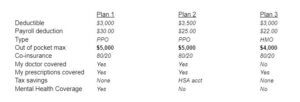
Continue on with the relevant information you gathered from your research above.
If your company only offers one plan, I would still run through the same investigation process so you can know what to expect. Specifically, you want to know if your current care providers are in-network and if your prescriptions are covered.
If they are not, then your costs will be significantly higher. You will then want to decide if you want to switch care providers to someone in-network and can find alternate prescriptions that would work for you.
If you are not able to change, you may consider looking on the Marketplace for a plan that will cover your providers. Even having to pay full price out of pocket for coverage, may allow you to find a policy that has discounted preferred provider pricing or a lower out-of-pocket maximum ultimately saving you money.

Evaluate your research
Review the chart you made and let’s look at some of the decisions to be made. First, determine what is most important to you. Cost of the plan or retaining your existing doctors and prescriptions?
In my case, I value the relationship I have built with my doctor, so I would not be interested in plan #3 because it would require me to find new primary care providers to be covered.
Now, let’s move down and evaluate each component of the plans. For each item, circle the item that has the best fit for you. Remember that this is subjective and personal to your values. There is no “right answer”, make the best decision for yourself as you are going through this.
- Deductible- Generally, the lower deductible is better especially if your future medical costs expect you to meet your deductible for the year. If you only go to the doctor once a year and have one prescription, you probably will not be anywhere close to meeting your deductible and may want to consider choosing a higher deductible plan to save monthly costs.
- Payroll deduction– How much will be taken out of each paycheck to cover your share of the premium costs. Generally, you want this to be a lower amount.
- Type– HMO, EPO, or PPO. This may not matter as long as your care providers are in-network.
- Out of Pocket Max- I want this to be lower if possible.
- Co-insurance– Generally you want the insurance company to be responsible for as much as possible.
- My doctors covered– How comfortable are you with the idea of changing doctors or paying out-of-network costs to see your existing doctors?
- My prescriptions covered– How comfortable are you with the idea of changing current prescriptions or paying out of network costs for keeping your current medication?
- Tax Savings– Does the account work with an HSA or does my employer offer an FSA account? If they do, am I interested in contributing to it?
- Mental Health Coverage- Do they provide mental health coverage and does it work with my current therapist (or desired therapist in my area)? Can you use FSA or HSA funds to pay for mental health care if the plan does not cover it?
- Any other items to determine? Unique components of the plan or specific needs I identified for myself in step #1? This will be a very personal determination specific to your personal needs.
So when I get done with this, I have a chart that looks like this:
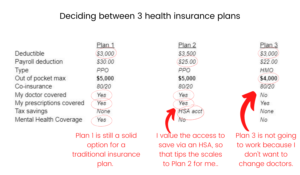
Now let’s look at what you circled on the plans. Was there any that you initially crossed out because it didn’t fit your needs (like #3 for me)? Of the remaining choices, which has the most circled items?
The plan with the most circles will probably be the best plan for you. Based on the example above and my values/needs based decision, the plan I would choose is #2. The deductible is slightly higher than plan #1, but I doubt I would meet my deductible for either plan, so I am ok with choosing #2.
What are you seeing from this exercise? Does one plan stand out to you, or are there 2 that are about equal? Think through your values and specific needs and make the best decision for yourself based on the results shown. Once you have decided on the plan, you will need to complete the paperwork to enroll when you are eligible. Your decision to enroll in this plan will be valid for the remainder of the year.
Congratulations! You are now ready to sign up for health insurance through your employer!

What other options do you have?
If you went through the entire process and didn’t come up with a plan that would work for you, what other options do you have? Consider the following:
- Covered under a parent’s policy (if under age 26 and with the consent of the parent and understanding of the costs incurred).
- Sign up for health insurance covered by a spouse/partner’s policy (each employer and plan have different rules about family coverage so review closely and look at the cost to your spouse/partner).
- Purchase coverage through marketplace/exchange (there would be a cost to this and you would not be eligible for any federal subsidy to lower the payment if you are offered insurance through work and decline coverage).
You can only select an insurance policy once a year during open enrollment so you are not locked into this plan forever, but it will be effective for the full year. You may be able to make changes during the year if you have a “qualifying life event” such as losing health coverage (spouse or dependent can be added to coverage), changes to family (marriage, divorce, additional child), geographic location change.

There was a lot of information in this article. Take time to dissect it and apply your values and needs to this situation. Don’t be afraid to ask HR questions to get the information you need. If they are not able to provide it to you, they should be able to connect you to a representative of the insurance company whose job is to help companies and employees sign up for their health insurance plans.
Don’t feel bad about reaching out, they are there to help you! Google any questions you have, take time to understand what you are signing up for. The world of insurance is complex and incredibly specialized. Sometimes it feels like a foreign language they are speaking! Take time to go through this and make a decision you are comfortable with. You totally got this!
What else do you want to know about how to sign up for health insurance through your employer? If you are covered, tell us what the signup experience was like? Easy, complicated? I would love to hear your stories and wisdom in the comments below or over on our Instagram page!



Very informative with great tips!
Thank you for the comment!