
Financial gurus are always talking about the Roth IRA and saying that everyone should have one. But blanket statements “like everyone should have one” doesn’t work for me! Finance is personal and unique to you! So, let’s look at who should open a Roth IRA so you can decide if one is right for you!
What is a Roth IRA?
If you are not familiar with the Roth IRA, here are the particulars to catch you up to speed! An Individual Retirement Arrangement (actually the A is not “Account” as most people assume!). An IRA is an investment account that you own and can be used to invest for your future retirement.
Roth is an indication that you fund the account with after-tax money (money you have already paid taxes on), and when you retire the withdrawals are tax-free.
Since this is a powerful account, the IRS sets limits on how much you can contribute each year. For 2022, the contribution limit is $6,000 per year, with an extra $1,000 catch-up contribution if you are over 50.
You can open this type of account at many different places, I recommend using either Vanguard, Fidelity, or Charles Schwab as they have great customer service and low fees.

The best part of the Roth IRA
The power of the Roth IRA comes in the tax-free growth in the account. You pay taxes on your contributions as you earn a salary, and then can withdraw your contributions and investment gains tax-free after you retire. If you open your Roth IRA in your 20s, this account has 40+ years to grow before you start withdrawing in retirement.
Let’s look at an example of an average worker who just finished college. Currently, the average salary of a person aged 25 to 30 in the US is $47,736 per year. To make the math a little easier, I am going to round that up to $50,000 for a person who is 25 years old and is working at their first job out of college. They are now eligible to contribute to their employer-sponsored retirement plan and chose to contribute 8% of their salary to their retirement account. They get a 2% raise each year and are looking to retire at age 65 (40 working years).
At the age of 65, their annual salary would have grown to $108,237, and their retirement account would be worth $2,367,816. Over 2 million dollars. By contributing just 8% of their salary each year. If they set it up to be automatic, through their employer, they probably never even noticed it.
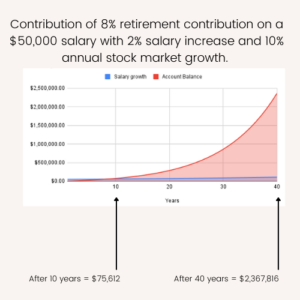
This is a prime example of the power of compound interest. The 40 years of potential growth allows the compounding effect to double your money 5-6 times before retirement. Those initial contributions you make in your 20s are the hardest working dollars you will have!
Don’t get distracted by the pile of money you will have if you follow the example above, this money is accessible to you without paying any tax on it. So, when in retirement you can take out a regular amount each month or use it for “fun spending” like vacations or a new car without it affecting the taxes you pay to the IRS. How powerful is that!
A Roth IRA is best for the following people
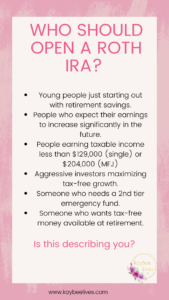
Young people just starting out with retirement savings
As I explained earlier, the power of compounding is the magic behind the Roth IRA. So, for someone who is just entering the working world, starting with a Roth IRA will give your contributions decades to grow tax-free.
People who expect their earnings to increase significantly in the future
This often falls in line with someone who is new to the working world. Often the first few years at a new position, your income is lower as you learn and prepare for promotions or job changes. As you significantly increase your income, there may be a time when switching to a Traditional IRA makes sense.

People earning less than $129,000 (single) or $204,000 (married) in 2022.
The limit for contributions in 2022 is $129,000 for single tax filers and $204,000 for married filing joint filers. There are special rules for the head of household or married filing separate filing statuses, so Google it if those are your tax filing statuses.
You do have to have earned income during the year to contribute. You can make a full contribution if you earn more than $6,000 of wages or self-employed income during the year, and a partial contribution if you earn less.
If you are married, and one partner doesn’t earn any income (a student or stay-at-home parent), they can still make a Roth IRA contribution as long as the other spouse earns $12,000 or more (spousal contribution).
Someone who wants to be aggressive in their account for maximum (tax-free) growth.
If you are a person who invests aggressively or likes speculative investments, then a Roth IRA is a great way to potentially capture aggressive growth tax-free! While I don’t condone speculative investing, if you are aware of the risks and comfortable with those risks, then the Roth IRA is a great vehicle to do that risky and speculative investing without having it affect your income and taxes each year.
As a 2nd tier emergency fund.
One of the unique rules of a Roth IRA is the government allows you to withdraw your contributions to the account at any time and without penalty. This is only for serious emergencies, like housing, job loss, or medical disasters.
So if you contributed $6,000 to your account last year, and it has now grown to $6,550. You could withdraw up to $6,000 with no penalty, leaving $550 in the account. Taking out anything over $6,000 would incur a 10% penalty.
Using your Roth IRA as a second-tier emergency fund would allow you to keep more money invested into growing assets in a Roth IRA rather than sitting in emergency savings account earning a small percent of interest.
Based on your personal situation and comfort level, I would make sure you still have 2-3 months of expenses in your easily accessible savings account emergency fund at a minimum. Then if a big emergency happens, like layoffs at work, you can eventually open a Roth IRA to provide you with 3-6 additional months of expenses as you look for a new job.
If the emergency is short-term, you can re-deposit any contributions taken out within 60 days without it affecting your current year contribution limits.

Someone who only has access to Traditional 401(k) or 403(b) options at work.
Tax diversification is important in retirement. Having a pot of tax-free money to draw from can save you a bunch in taxes when you need extra funds in an otherwise high tax year. The Roth IRA can give you flexibility in income sources down the road. Plus if you don’t end up needing these funds in retirement, the Roth IRA is simpler to transfer to your heirs upon passing.
Who shouldn’t use a Roth IRA?
The Roth IRA is an incredibly beneficial account to have. There are very few people where contributing to a Roth IRA doesn’t make sense.
If your household income is over the contribution limit.
If that is you, then you can still have a Roth IRA open, holding money in the account, you just can’t make any new contributions in a year if your income is over the limits listed above.
On the other hand, you (or your spouse) does have to have earned income in order to qualify to make contributions. So if you have no earned income (wages, self-employment income), then you are not eligible for a contribution.

People who are close to retirement.
People who are within a few years of retiring often would be better off contributing to their Traditional IRA instead. More than likely they are at peak income earnings and would benefit from a tax break now. Plus they will be using the account when they retire in a few years, which means there is minimal time for tax-free growth.
People who are not getting their full employer match.
People who are not contributing up to the full match at their employer-sponsored plan. If your company matches up to 5% of your salary, and you are only contributing 3%, then you are missing out on 2% of free money each year. Your first priority should be getting the full match in your employer-sponsored plan, and then look at investing extra money for retirement into a Roth IRA.
Savings towards retirement is never a bad choice! As long as you meet the income requirements to contribute to a Roth IRA, making a contribution is a good choice. If you are stuck deciding between Roth and Traditional, just pick one! They are both amazing options. Don’t let decision paralysis rob you of more years for your contributions to grow!
Have I convinced you to open a Roth IRA if you don’t already have one? They are an incredibly powerful tool to use for your retirement, especially if you have time on your side! If you are not sure how to manage your retirement investing while paying down debt, I have some tips and tricks to help you out! Are you investing in a Roth IRA currently? If so, share it with us on our Instagram post!


Leave a Reply