
Albert Einstein once called compound interest the 8th Wonder of the World. You might be thinking, ok crazy old guy, what does the few penny’s my savings account earn each month have to do with the Colosseum or Great Wall of China? Well, the dude isn’t crazy. Let’s go through the mechanics of compound interest and see if we can understand why Albert thinks so highly of this thing called compound interest.
What is interest?
The term used is interest, which everyone associates with their savings account. A better way to look at this is growth. Savings accounts grow through interest accumulating in the account. Savings account interest rates are so low right now (like 0.3% to 0.5%), that it takes an incredibly long time to start to accumulate and see a measurable increase in your savings account.
For the examples today, I will be using the stock market returns where you have your retirement account invested. This figure includes the dividends a stock may pay to its owner/investor, as well as the increase in share price over the course of the year. Both of those combined are known as the rate of return or growth.
Over this article, I will use a stock market average rate of return of 10% per year. This is a simplified figure which doesn’t factor in inflation but is useful as an example in understanding the theory.
How does interest compound?
In this context, compound means to add to or combine multiple parts into one. So, you are taking your initial investment, and then the growth is adding to it for multiple years over and over.
Let’s look at a simplified version of this in the context of your IRA account:
In year 1, you make your initial contribution of $6,000 and at the end of the year dividends and growth are added at 10% ($600) so your account is now worth $6,600.
In Year 2, you again contribute $6,000 and at the end of the year dividends and growth are added at 10% ($1,260) and your account is now valued at $13,860.
So the compounding comes from the addition of initial contribution, growth on that, and then year over year growth on growth. Let’s skip ahead a few years and look at what year 10 would look like.
Year 10 you again contribute $6,000. Over 10 years, you have contributed a total of $60,000. Your 10% dividends and growth on the value of the account is $9,562 for this year (Yes you read that right. There is more growth for the account than you contributed for the year!) and the current value of the account at the end of year 10 is $105,187. What! Over 100K!!! And you only contributed 60% of that amount, the rest is dividends and growth compounded or added to over the years.
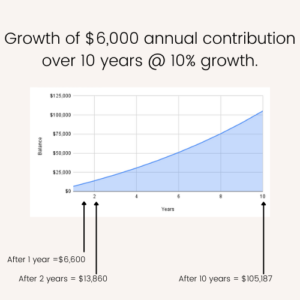
So there you have it, take both growth and “over and over” together and you have compound interest. Look at the growth difference from year 1 to year 10. Year one earnings were $600. Not that impressive. Year 10’s were $9,500! That is way more than you invested in the account for the year.
Let’s check out what compound interest can do if you add the magic ingredient…… Time.
How does time factor in?
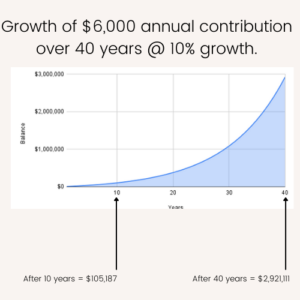
Let’s take our previous example a little farther. What if you continue to contribute $6,000 every year for 40 years, which grows at 10% every year. That would be a working person from the age of 25 until retirement at 65. You would have invested $240,000 of your own money. How much do you think the account would be worth when you are 65 and ready to retire? 750,000? Maybe a million dollars? Scroll down below this picture to see the answer.

$2,921,111……. Yes, that can be rounded up to THREE MILLION DOLLARS. In the final year of savings, you contribute $6,000 and the account earns dividends/growth of $265,556. Overall during this 40 year period, you contributed $240,000 of your own money and earned $2,681,111 of growth.
That is a heck of an investment!
As you can see from the graph below, the later years’ growth is exponential. If you only invest for a shorter period of 15 or 20 years or take money out at various times, you lose out on that growth on top of growth compounding.
But only rich people can afford to invest like this, right?
Let’s look at an example of an average worker. Currently, the average salary of a person age 25 to 30 in the US is $47,736 per year. To make the math a little easier, I am going to round that up to $50,000 for a person who is 25 years old and is working at their first job out of college. They are now eligible for retirement and chose to contribute 8% of their salary to their retirement account. They get a 2% raise each year and are looking to retire at age 65 (40 working years).
At the age of 65, their annual salary would have grown to $108,237, and their retirement account would be worth $2,367,816. Over 2 million dollars. By contributing just 8% of their salary each year. If they set it up to be automatic, through their employer, they probably never even noticed it.

What if their employer was generous and gave them a 50% match on their contribution, which is an extra 4% per year? Their retirement account would be worth $3,444,097. An additional 1 million dollars courtesy of their employer. That is a generous retirement gift!
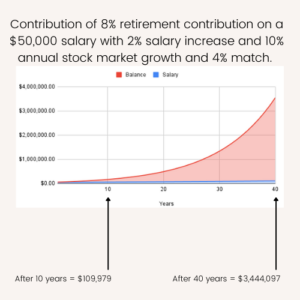
All this from a very attainable $50,000 annual salary starting out. If your salary grows more than 2% on average, you will end up with an even larger balance at retirement.
How momentum factors in.
Momentum in growth really takes hold when the annual growth of the account is greater than the amount you are contributing each year. For our first example of contributing $6,000 annually to an IRA, the point of momentum taking hold is year 8. The growth for year 8 is $6,862, which outpaces the $6,000 contribution for the first time.
Starting out can feel slow. 
You are seeing just a fraction of your contribution being added through growth for the first many years. Don’t give up! This is where you practice your patience! Just keep contributing. If the small growth bums you out, then don’t look at the account. Just set up automatic contributions each month or once a year and let it do its thing. Check it at the 10-year point and see what you find.
So what do I do now?
First, go back and apologize to Mr. Einstein, he isn’t a totally crazy dude. With enough growth and time, compound interest is a powerful effect.

Now, the thing to do right now is to start saving for retirement either in a 401(k) (or similar account) through work or in your own IRA account if you are not already doing so. The general consensus is to start out saving 10% of your salary into a retirement account annually.
Invest it in a low-cost, broad stock market index fund within your 401(k) or IRA similar to a Vanguard Total Stock Market Index Fund, Schwab Total Stock Market Index Fund, Target Retirement fund, or Fidelity Total Stock Market Index fund.
If you can’t start at that amount right now, start with a lower % that you can afford, then increase the % you are contributing by 1% each year and every time you get a raise, but half your raise into your retirement account. Within a few years, you will be up in the 10%-15% range. Once you are there. Set it and forget it!
Secondly, Do not touch this money. It is for retirement, and not any other purpose outside of a crisis-level emergency (like homelessness or catastrophic medical expenses).
If you leave your job, roll over your 401(k) into your personal IRA account, and then start contributing to your new job as soon as you are eligible. Doing this will keep the time factor going and you will not lose much growth.
Don’t watch this money too closely. I used a steady positive growth rate of 10% in my examples as an average of the stock market growth over the past 100 years. In the real world, annual returns over a period will look more like 5%, 2%, -2%, 17%, 8%. You have to be ok with watching your account go down over some periods, knowing it will grow in the future.
If you are going to panic sell when the market drops, then you need to not look at the account! Check it once a year and no more!
If you are already contributing to your 401(k) and IRA, then you have done the hard part already. Now you can just sit back, don’t withdraw money, and let time start to compound the growth.

Retirement accounts can feel overwhelming to many. All the different terms and rules that go with them sound like a foreign language. This will be the start of a group of posts over the next few months covering how to open an IRA or 401(k), what to invest in, and how to look at your risk tolerance in your account. Stay tuned for those posts!
Ok, so there is a ton of information in this post. What takeaways did you have from it? Do you have any questions that I didn’t cover? If so, leave them in the comments or on our Instagram post and I will answer them.


This is a great informational post! Wow what Math about 25-65 years with retirement money in millions. I am an educator and do invest some regularly
It is amazing what can happen to a small amount invested for many years. Thanks for the comment!
This is such a great post! I never even thought about a lot of this stuff but I really should invest more. It’s crazy how a small amount can turn into so much money!
Loved reading this post! Never really thought about it, but you explained it so clearly! Had a good laugh about Einstein! Thank you!
Good old Al redeemed himself in the end! Glad you enjoyed it~
It’s amazing what small money decisions you can make now that will reap huge rewards in the future! My husband and I have started investing our money for this very purpose and it makes me feel so much more secure in our future.
You provided a lot of great tips and definitely the best thing to do is to not touch it!
I love this so much! You can always invest no matter what phase you are in your financial journey. Thank you for the motivation!
Small amounts add up if you give it enough time! You can totally do it!
Excellent advice. We need to start teaching this in primary schools. From day 1 of earnings if we all did this can u imagine the difference. Wow!
Good post. I am really bad in investments but thanks to this post my ideas are now bit more clear.
This is super helpful and informative! I’m not the best when it comes to finances and investments, that’s my husband’s area of expertise. Thanks for all of this info. =)