
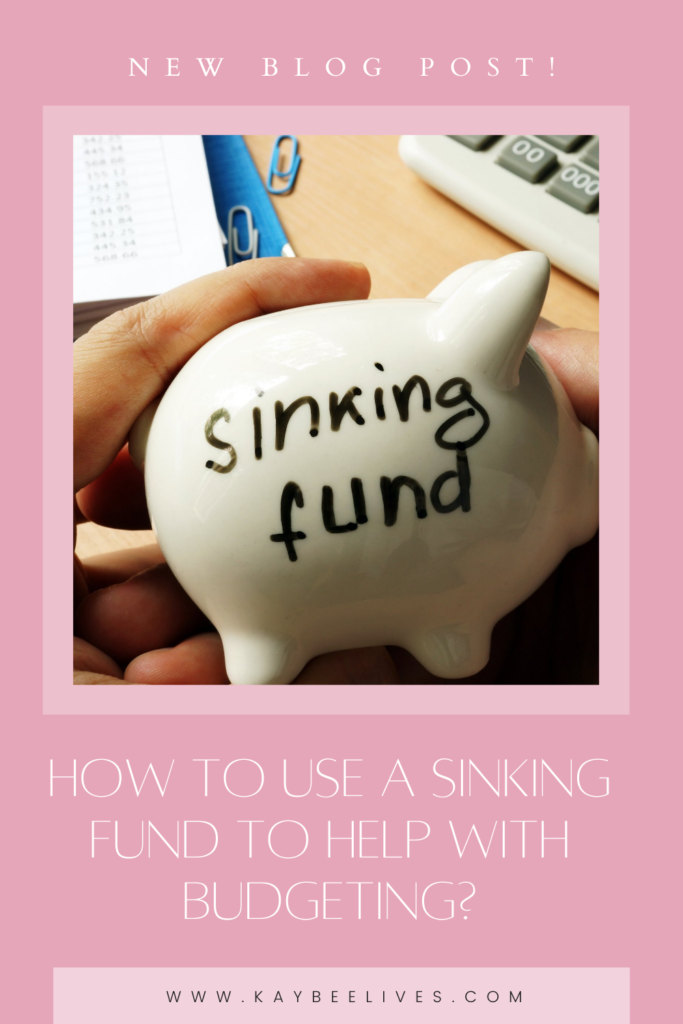
Sinking funds are not a common financial term, but I think more people will be familiar with the idea than they are the name! Sinking funds are a great tool to supplement your existing budgeting and help smooth out those annual expenses that can be painful when they hit! Today we are talking all things sinking funds, how to use sinking funds, and how they can help with your budgeting!
What is a sinking fund?
A sinking fund is an account set up where you divert money monthly from your budget, to help pay for a known annual expense. Its purpose is to make those large annual bills, be less painful since you have the money set aside and are budgeting for it monthly.

When a $1,000 car insurance bill comes once a year, you are not eating beans and rice for the month to try and pay for it. Instead, you are setting aside $83.33 a month into this sinking fund so that the money is there waiting when the bill arrives. In your budget, the car insurance amount is a fixed amount each month being sent to your sinking fund, rather than your car insurance company. You get to earn the interest on that money, instead of paying it to them!
How do I set one up?
Simple! It is just a separate savings account that you have. Some people like to have a separate sinking fund for each of their annual expenses, but you can simplify things and just have one called “sinking fund” or “annual expenses”. I would look for a High-Yield Savings Account like Ally.
Personally, I have two sinking funds. One for my car, where I can put money towards oil changes, new tires, or unexpected maintenance. When my starter died a couple of months ago, I was so thankful for this account! This account will also double as a down-payment savings account for my next car. My second sinking fund is for everything else. I use it for a few annual subscriptions, car insurance, and to pay for my July and August water bills that jump from $70/month to $200/month in the summer (stupid grass!)

How do I know how much to put in a sinking fund?
Take some time to review your finances and find all of the annual expenses that you have. A list of common ones to consider are:
- Car insurance- some will give you a discount if you pay in full at the start of your year.
- Subscriptions- Amazon Prime is a great example! Think about any other dues, memberships, or annual subscriptions like AAA
- Property taxes, HOA, and home insurance- If you have a mortgage, your attached escrow account is a sinking fund. Most mortgages require an escrow account they control, but if yours doesn’t then start a sinking fund so you don’t dread property tax time!
- Christmas gifts- Start saving now for next Christmas!
- Car registration or maintenance- This is not always predictable, but if you are thinking your car may need some work in the future, start a car sinking fund and fund it to cover basic maintenance like oil changes and future tires or other repair work.
- A large expense that happens once a year like snow removal in the winter or pool maintenance in the summer.
As you find each of these expenses, make a note about how much it costs you each year for it. Once you have them all, add up the annual cost to get an annual total. Then divide by 12 and that is the amount you need to set up as an auto-transfer from your checking account to your sinking fund each month.

My annual expenses look like this:
- Amazon prime: $140
- AAA: $101
- Car insurance: $680
- Summer lawn watering: $300
- Total: $1,221
- Monthly cost: $101.75 (annual cost divided by 12)
I like to give myself a little buffer, so I set an automatic transfer up for $110 a month. Make a note in your calendar to revisit this calculation once a year or so and adjust the transfer if needed. You can transfer the money monthly, or after each paycheck, if that works better. Just divide the annual total by the number of paychecks you receive in a year.
Budget tip! While you are finding these annual expenses, take a minute and see if there are any that you are not using or don’t feel is worth it anymore. Often subscriptions auto-renew and we don’t even notice the cost. Take a moment to cancel them right now and save yourself some money!
How can it help with budgeting?
Sinking funds help smooth out the budget bumps that happen once a year. Without sinking funds, you would have a few months with a large expense that your excess cash flow cant cover. You can choose to dip into savings for this, but using a sinking fund is a great way to plan ahead proactively to cover these expenses.

In your monthly budget, you will have a fixed transfer to your sinking fund savings account. Then you don’t have to worry about those large annual expenses breaking your budget for the month.
When the big annual bill comes, make a transfer back from the sinking fund to your checking account and pay it off! No stress, no worry!
So, how are you going to incorporate sinking funds into your budget? After learning about how to use sinking funds, do you think it is something that will help your budgeting? I would love to hear about if you use sinking funds in the comments below or over on Instagram!


I didn’t know these type of funds had a name!
I actually learned a good hunk of information from this and think it could be really handy right now as my husband and are saving to buy our first home
That’s great! Congratulations! A sinking fund can be used to manage to buy all of the “new house things” that come with owning and decorating your house! It can also be helpful as a way to save up for maintenance that will be needed in the future! Good Luck with the home purchase!